

What is the best recovery channel for processing your cigarette butts?
and why cigarette butt disposal has become a major issue for companies
Despite ashtrays being installed everywhere, cigarette butts continue to be thrown on the ground. And when we try to "recycle" them, another problem arises: the term "recycling" is used by everyone, sometimes incorrectly.
Why do some people use the word recycling for processes that aren't really recycling?
Why do we still mix up "energy recovery," "recycling," "treatment," "industry," and "CSE" as if they were synonyms?
And above all: what is really the best way to treat a cigarette butt today?
Between marketing arguments, semantic shortcuts, promises of a circular economy, and talk of energy recovery, it's difficult to know what is technically accurate, environmentally relevant, and truly aligned with a serious CSR strategy.
In this article, you will discover:
- How to navigate all the "recycling channels," what they are and what they are not;
- Whether it is better to burn or wash a cigarette butt to clean it up;
- A comparison of the different treatment channels: Recycling to make new plastic materials; recycling to make insulation; energy recovery (very high temperature incineration);
This article is not intended to defend any particular method, but rather to help you choose the solution that best suits your needs, your budget, and the way you want to involve your teams.

Before even talking about outlets—material recycling, recycling for insulation, energy recovery—it is important to understand why cigarette butts have become such a hot topic in companies. This is neither a CSR fad nor an environmental obsession: it is a real, visible, costly, and measurable problem.
A tiny piece of waste... but one of the most polluting and persistent
Cigarette butts are microplastics disguised as cotton. Their filters, made of cellulose acetate fibers, take several years to degrade and release thousands of chemical compounds (nicotine, heavy metals, hydrocarbons) along the way.
According to a professional website, these particles end up:
- in the soil,
- in runoff water,
- and sometimes in technical networks.
A cigarette butt on the ground is therefore not just a "cleanliness issue": it is a diffuse pollutant that is difficult to contain and impossible to collect completely once it has scattered.
An immediate impact on the site's image and credibility
Just a few cigarette butts on the ground in front of the main entrance are enough to spoil the first impression visitors have of your site.
Smoking areas are logically located in the busiest areas, which reinforces the strategic importance of keeping these areas clean.
In internal QWL surveys, this is one of the most frequently cited sources of dissatisfaction: "cigarette butts in front of the entrance," "dirty smoking areas," "overflowing ashtrays."
A hidden but very real operating cost
Cleaning teams spend time—sometimes a lot of time—picking up scattered cigarette butts.
For the company, this means more micro-cleanings and more visits for a cleaning service that costs more and is less effective.
On a multi-building site, this wasted time ends up costing more than setting up a proper waste management system.
A topic now linked to CSR, compliance, and reporting
Cigarette butts are paradoxical objects: insignificant individually, but very useful in environmental reporting.
Why?
Because they are visible and quantifiable, directly correlated to a concrete action by employees, and above all highly symbolic of the maturity of teams in terms of waste sorting.
In the context of ISO 14001, non-financial reporting, or internal carbon assessments, cigarette butt management ticks several key boxes: control of environmental aspects, diffuse waste, cleanliness of surroundings, and reduction of impacts.
The waste hierarchy: why recycling and recovery do not play the same role
To fully understand the role of recycling and energy recovery, we need to return to a founding principle of all environmental policy: the waste management hierarchy, also known as the reduction pyramid ( notably adopted by the EU in Directive 2008/98/EC). This pyramid ranks treatment methods from the most virtuous to the least virtuous, not to judge, but to guide decisions according to their real impact.
Prevention (avoiding waste)
This is the highest level. In the case of cigarette butts, this means one simple thing: preventing them from falling to the ground and polluting rainwater. This requires proper layout of smoking areas, effective design, regular maintenance... and, in some cases, a behavioral approach (signage, rewards, collective commitment).
Reuse/recycling
There is no real reuse of cigarette butts as such, but this level highlights an essential idea: anything that extends the useful life of a product or prevents waste generation is a priority.
Material recycling
Recycling involves transforming cigarette butts into a new raw material. This is where recycled plastic and insulation recycling industries come in. We refer to this as recycling because the material is recovered, purified, reformed, and then reintroduced into the economy.
Energy recovery
Using cigarette butts as fuel in an efficient incineration facility. This is not recycling in the strict sense (since no new material is created), but it is a recognized and useful form of treatment for certain types of waste.
This pyramid reminds us of one simple thing: not all solutions serve the same purpose, and that's okay—as long as we know where we stand.
Material recycling makes sense when a company is seeking to implement a circular economy approach, material transformation, and reporting.
Energy recovery makes sense when stability and energy efficiency are priorities, or when a material recovery channel is not available.
The challenge for the company is therefore not to choose "the best" solution in absolute terms, but to identify the most consistent solution according to its priorities: environmental impact, budget, logistical constraints, and level of team commitment.
The three main types of vents: what is recycled, what is not, and why
Before getting into the technical details, it is essential to establish a solid foundation: not all cigarette butt treatment solutions serve the same purpose. They start from the same premise—preventing cigarette butts from polluting soil and water—but then follow very different approaches.
Today, there are three main types of disposal methods:
1. Material recycling, which transforms cigarette butts into a new plastic material.
2. Insulation recycling, which uses cellulose acetate to produce insulation panels.
3. Energy recovery, which uses cigarette butts as fuel in specialized facilities.
These three approaches are all legitimate. They can all be relevant, depending on the site, volumes, CSR policy, geography, or budget. But they are neither equivalent nor interchangeable, and above all, they cannot all be called "recycling" in the strict sense of the term.
Material recycling: the process that transforms cigarette butts into new materials
This is the most intuitive process: the one that corresponds to our idea of "recycling" in the circular economy.
What this recycling process produces
Material recycling transforms the filter of the cigarette butt—cellulose acetate—into a recycled raw material used to manufacture recycled plastic pellets that can be used to make:
- small technical parts that will not come into contact with food,
- accessories or furniture components, including composters.
In other words: plastic waste is recovered to make... new plastic material.
Why is this considered recycling "in the strict sense"?
Because the initial material is recovered, decontaminated, transformed, and then reintroduced into a production cycle. This is exactly the definition used in European Directive 2008/98/EC, circular economy legislation, and by ADEME.
The key point: decontamination
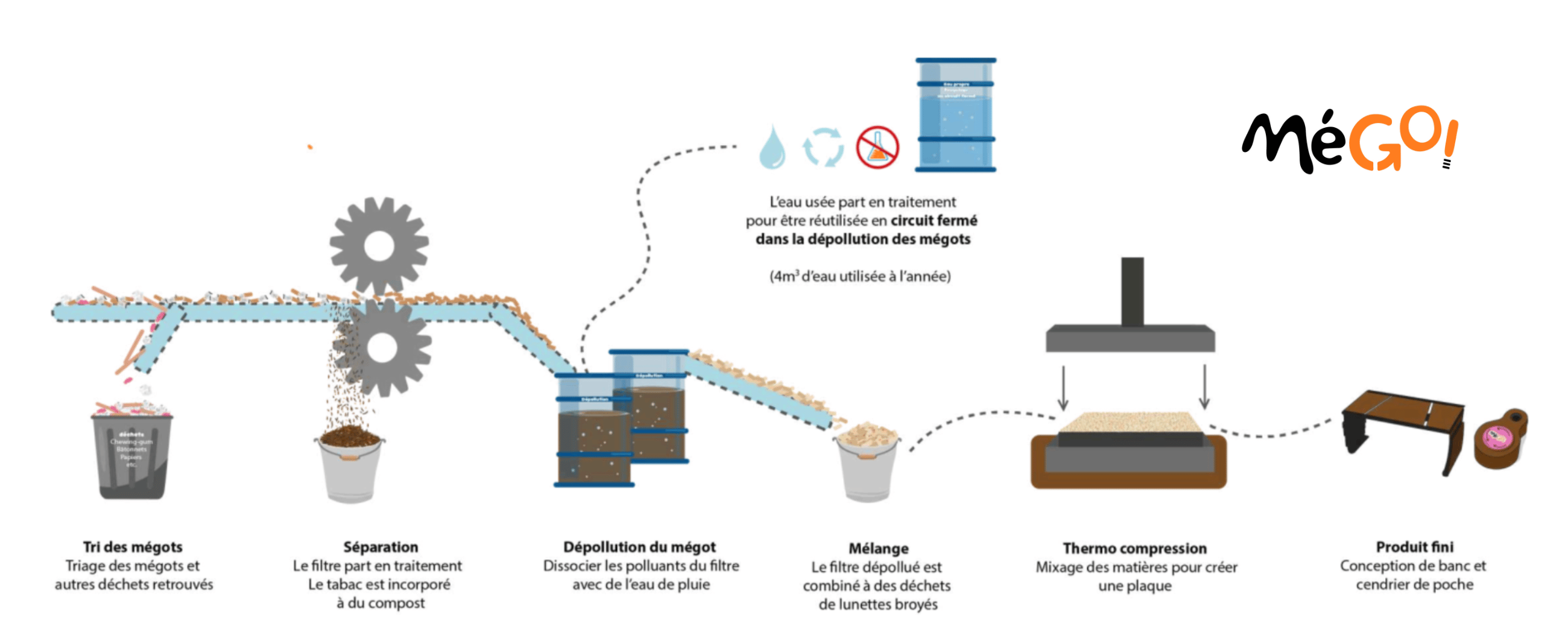
This recycling process always requires the different components of the cigarette butt to be separated, i.e., organic matter (tobacco residue) and contaminated plastic (the cellulose acetate filter). The filter is then washed with rainwater to separate the pollutants from the rest. The wastewater is treated so that it can be reused in a closed circuit for the decontamination of cigarette butts.
For example, the MéGO! recycler uses only 4m3 of water per year to recycle millions of cigarette butts.
Insulation-oriented recycling: another form of material recovery
Alongside plastics manufacturing, there is another option: transforming cellulose into insulation panels. Here too, cigarette butts are collected, sorted, and cleaned.
But instead of being injected into a plastic manufacturing process, the purified filter is compacted or agglomerated to produce insulation material.
This process relies on the natural physical properties of the filter: lightness, low thermal conductivity, and absorption capacity. It creates a coherent outlet, particularly in sectors seeking innovative insulation solutions or lightweight composite materials.
This approach remains less widespread than plastics manufacturing, but it follows the same logic: the material is reused, not destroyed.
It is therefore indeed recycling.
Energy recovery: a useful solution, but different from recycling
The third option, often presented as "recycling," actually involves using cigarette butts as fuel in specialized facilities—sometimes in the form of prepared combustible waste, sometimes as part of a larger waste stream. The principle is simple: cigarette butts are burned at very high temperatures and used to produce heat or electricity.
These processes are known as SSF (Solid Substitute Fuel) or SRF (Solid Recovered Fuel) because they prepare cigarette butts with other combustible waste to be used as fuel in industrial facilities. Incineration remains the final process in these chains.
In this case, combustion at very high temperatures enables effective decontamination and total elimination of all polluting and toxic components.
This treatment plays a real role in waste management: it ensures controlled disposal, contributes to energy production, and provides a stable outlet when no material processing is available locally. It is a relevant solution for certain sites or for small volumes. It also saves fossil fuels such as gas for industries that require very high-temperature furnaces, such as cement plants.
Another advantage of this process is that it is at an advanced stage of maturity, which translates into energy efficiency and good performance. In other words, if we look at life cycle analyses, incineration (CSE, CSR, etc.) has a smaller carbon footprint than some recycling processes that are less mature because they are newer and therefore inevitably less efficient and effective.
But it is not recycling. The material is not recovered: it is destroyed. The end result is energy, not a material that is reintroduced into the economy. This is why regulations classify this process as energy recovery, not as part of the circular economy.
For a company, the challenge is therefore not to judge this sector—it may be very suitable in certain contexts—but to understand that it serves a different purpose: recovering waste rather than transforming its material.
To clean up a cigarette butt, is it better to burn it or wash it?
Both work and are effective processes! But in the first case, combustion is used as energy for industry, while in recycling, cigarette butts can be recycled into a new material and given a new lease of life.
How to choose the right channel: material recycling, insulation recycling, or recovery?
Once the three options have been clarified, the question facing most companies is simple: which one to choose?
And as is often the case in waste management, there is no one-size-fits-all answer. It is neither "material recycling for everyone" nor "incineration in all cases." It all depends on the context of your site, your volumes, your budget, your CSR maturity, and the logistics at your disposal.
You have a clear circular economy ambition → prioritize material recycling
For a company that explicitly seeks to integrate a circular approach, produce credible environmental reporting, demonstrate that materials are truly being reused, and promote its CSR actions to teams and stakeholders, material recycling is generally the most consistent option.
It is the only process that guarantees that a cigarette butt becomes a new resource and not just fuel.
It also has the advantage of being visual: showing a composter or a product made from plastic derived from cigarette butts makes the action tangible for employees.
This process is particularly suitable for organizations with ISO 14001 certification or those engaged in non-financial reporting initiatives.
Your volumes are low or irregular → What is the best solution?
Contrary to what is sometimes said, the choice between material recycling and energy recovery is not a question of the volume produced by a site. Just because a site generates few cigarette butts does not mean it should turn to incineration.
Material recyclers can process very small volumes as well as massive volumes—it is not the volume itself that is the problem.
What makes all the difference, however, is the available logistics and the ability to massify collection.
The material recycling sector is based on a simple principle: cigarette butts must be collected, stored in a dry place, collected regularly, and then transported to a decontamination unit. If this logistics chain exists—either because the company uses a specialized service provider or because it pools volumes with other sites—then material recycling remains perfectly viable, even for sites that produce very little.
Energy recovery becomes relevant when local massification is not possible.
This can happen in three types of situations:
- The sites are too far away from a material recovery facility, making transport disproportionate to the intended impact.
- No local service provider collects materials, forcing the company to organize its own logistics, which is too cumbersome.
- The geography of the area (isolated rural areas, regions without an established recycling industry) makes access to recycling more complex.
In these cases, the energy sector offers a stable, consistent, and proportionate outlet, as it uses existing logistics flows: residual household waste flows, mixed combustible waste flows, or local industrial sectors using alternative fuels.
In other words, the most virtuous sector is the one that is realistic in your geography and optimizes your service provider's logistics.
Material recycling is not "reserved for large sites," just as recovery is not "reserved for small ones."
It is a question of local infrastructure, not volume.
Want to get your teams on board → avoid invisible channels
Material recycling has an often underestimated advantage: its educational value.
Employees understand a process better when they can visualize:
what has become of "their" cigarette butt, what the recycled material looks like, and what end product it has been turned into.
Energy recovery, although effective, remains an abstract process that is difficult to symbolize. It works very well on a strictly operational level, but it is less effective at engaging teams in a virtuous cycle.
For organizations seeking to change behaviors—particularly reducing cigarette butts on the ground—the material sector is often more effective at mobilizing people.
You need detailed reporting: pay attention to words and evidence
This is one of the most sensitive issues. In a serious CSR policy, a dashboard must make a strict distinction between material recycling, energy recovery, and disposal.
The terms must be accurate. Incineration, even highly efficient incineration, cannot be counted as recycling.
ISO certifications, external audits, carbon footprint assessments, and SFDR reporting require precise traceability:
- where do cigarette butts go?
- what materials are recovered?
- what percentage is actually processed?
Choosing a sector therefore means being able to document flows, not just delegate them.
In summary: the best approach is not universal, but contextual.
You want circular economy, meaning, education → material recycling.
You want a simple, stable solution for small volumes → energy recovery.
You want a material alternative with innovative technical applications → insulation recycling.
The important thing is not to choose "the best" option, but the one that is consistent with your site, your CSR objectives, and your logistical resources.
The real challenge is not the industry... but the ability to catch cigarette butts before they hit the ground.
Since the beginning of this article, we have talked about waste streams, treatment, decontamination, and the circular economy. But there is one reality that every professional in the field knows: what is the point of comparing waste streams if cigarette butts don't even make it there?
This is the sector's great oversight. On the one hand, we debate recycling, incineration, CSE, materials, and energy. On the other, we forget one basic fact: according to ADEME, one in two cigarette butts ends up on the ground, even when an ashtray is nearby.
In other words, the primary factor in environmental performance is not the sector, but collection. A perfect sector will never compensate for a poorly functioning smoking area.
Environmental performance depends primarily on the terrain
You can have the best pollution control technology in the country, but if 40%, 50%, or 60% of cigarette butts end up on the ground, pollution remains, the site's image is damaged, and cleanup costs continue to rise.
The opposite is also true: a very simple process becomes extremely effective when 90% or 95% of cigarette butts are collected.
Why cigarette butts actually end up on the ground
If cigarette butts end up on the ground, it's not because of widespread incivility. It's an accumulation of micro-details related to design, usage, and psychology.
Often, the ashtray is there... but it's not used because it's poorly placed, not very visible, too high, too far away, or simply full. A poorly designed ashtray automatically discourages people from using it. A dirty ashtray discourages them twice as much.
There is one last point to add: the lack of meaning. For many employees, throwing a cigarette butt in an ashtray is "pointless"—they see neither the benefit nor the result. And a gesture that makes no sense is a fragile gesture.
The trio that changes everything: location, design, behavior
An effective system is based on three concrete pillars, which are often more important than the outlet itself.
First, location: an ashtray must be placed exactly where people actually smoke. Not two meters away, not behind a blind spot, not downwind. It's more a question of ergonomics than technology.
Next, design: a good ashtray should encourage people to use it. An intuitive opening, good visibility, slow filling, easy emptying... These are the elements that prevent cigarette butts from ending up on the ground.
Finally, behavior: a gesture becomes sustainable when it makes sense. Showing the recycled material, displaying the volumes collected, highlighting progress and, in some cases, introducing a positive mechanism such as "1 cigarette butt = 1 cent for charity" profoundly changes the commitment of teams.
When these three levers are activated, we are able to recover a higher percentage of these cigarette butts.
Why discussing sectors without talking about the field is a false debate
Today, many companies spend hours comparing material recycling, insulation recycling, and energy recovery. However, the real question should be much simpler:
How many cigarette butts does your site actually capture?
Because no system, even the most efficient one, will recover the cigarette butts left in front of the building entrance. A clean, well-equipped, and well-designed site has more impact than an ultra-virtuous but underfed recycling system.
What this means for choosing a field of study
When you look at the issue from this angle, everything becomes clearer.
The choice of sector—materials, insulation, or energy—must be made after securing collection, not before. This is because no sector is ever "the absolute best": it may or may not be consistent with an organization, a territory, logistics, and internal maturity.
The reasoning then becomes simpler:
- if you collect your cigarette butts effectively, you can opt for material or insulation recycling;
- if local massification is impossible, energy recovery may be the most logical solution;
- if your priority is to get your teams on board, material channels offer a stronger visual and educational impact.
The right channel is one that is realistic and consistent with your field.
The role of a partner: making the sector truly effective
The role of a service provider is therefore not just to send your cigarette butts "somewhere."
It is first and foremost to ensure that the cigarette butts get there.
This work is not done in the recycling plant. It is done on your sidewalk, under the smoking shelter, your main entrance, your cleaning routines, your signage, and the behavior of your teams.
A useful partner is one who:
- designs intuitive smoking areas,
- offers reliable cigarette butt collection,
- chooses the recycling or energy recovery channel best suited to your location,
- And above all, gets all teams and users on board with sorting.
Conclusion
At this stage, one thing is very clear: the debate over"which system is best?" is often misguided. The real issue is not choosing between materials, insulation, or recycling, but ensuring that cigarette butts actually reach the chosen system. An effective system will never compensate for a poorly designed smoking area, a poorly placed ashtray, or a meaningless gesture on the part of users.
Only then does the choice of channel come into play. There is no universal solution, only solutions that are consistent with:
- your logistics,
- your territory,
- your CSR ambitions,
- your desire to involve your teams or not.
Material recycling brings meaning and circularity. Recycling for insulation opens up interesting technical opportunities. Energy recovery remains stable, mature, and relevant when there is no possibility of mass production.
In all cases, environmental performance depends first on capture, then on the choice of a serious, traceable, and appropriate outlet. A useful partner does not just sell a single solution: they design a coherent system that allows your cigarette butts to be properly collected, properly cleaned up, and properly recycled.